Dead Center vs Live Center: Which Tailstock Center for Your Lathe
Short answer: a dead centre is a fixed carbide or steel point that supports the workpiece by sliding friction; a live (rotary) centre carries the same load on bearings and spins with the part. Use a dead centre for the highest accuracy at low speed and light load; use a live centre for higher speed, heavier load and flood coolant. Match the Morse taper (MT2–MT6) to your tailstock and the point angle to your centre hole.
Why the two exist
A tailstock centre does one job: hold the far end of a shaft true to the spindle axis so it does not sag, deflect or chatter while you cut. A dead centre has no moving parts — the point stays still while the workpiece turns against it. That gives the best possible alignment, because nothing rotates except the part itself. The trade-off is friction: the point rubs in the centre hole, generates heat, and needs lubrication in the hole to avoid galling.
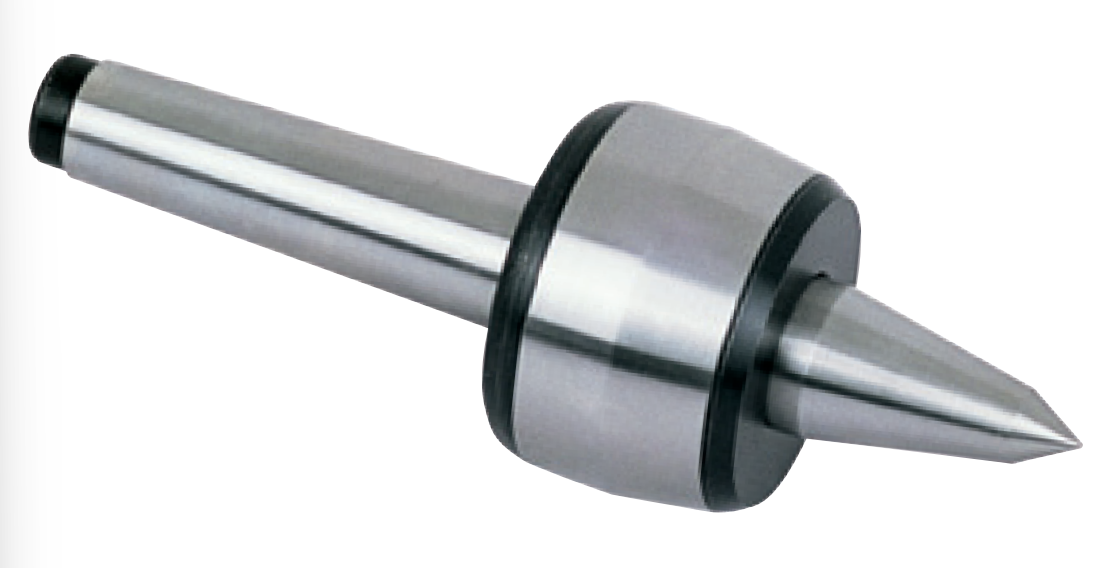
A live centre replaces that sliding contact with a bearing pack, so the point turns with the workpiece. Friction moves into the bearings, the part stops grinding against the point, and the centre can run faster and carry more load without heating the centre hole. In exchange you add moving parts, a little bearing runout, and a higher price. The bearing quality is what separates a cheap live centre from a good one: a sealed angular-contact plus thrust bearing pack stays accurate and lasts, where an open plain bearing lets coolant in and fails early.
Morse taper basics
Both centre types seat into the tailstock quill on a Morse taper, sized MT2 through MT6. The taper locks by friction, so the shank and the quill bore must be the same size — an MT3 shank will not seat in an MT4 quill, and forcing it with an adapter sleeve reintroduces runout. The point itself is a 60° cone (or 75° for some hollow parts) that rides in a matching centre hole drilled with a centre drill. If the point angle and the hole angle disagree, contact happens on a ring instead of a full cone and the part is not supported properly.
Comparison
| Dead centre | Live (rotary) centre | |
|---|---|---|
| Rotating parts | None — point is fixed | Bearing pack (angular contact + thrust) |
| Accuracy | 0.01 mm, carbide tip | 0.01 mm, bearing-mounted point |
| Speed limit | Low — friction heat | High — bearings take the load |
| Load | Light to medium | Medium to heavy |
| Lubrication | Required in the centre hole | Sealed, maintenance-free |
| Coolant / dust | Not applicable | Waterproof, dustproof seal |
| Tip | Carbide, hardness above HRC85 | Hardened point on bearings |
| Cost | Lower | Higher |
| Best for | Fine finishing, grinding, inspection at low speed | Turning, high-speed production, heavy work |
The third option: bull-nose centre
A bull-nose centre has a large-diameter head (Ø63–Ø410 mm in our range) instead of a sharp point. It supports hollow or tubular workpieces from inside the bore, where a standard 60° point has nothing to engage. Head angle is 60° or 75°; pick the one that matches the chamfer on your part. Bull-nose heads are almost always bearing-mounted (live), because a large-diameter head on a dead centre would rub at high surface speed and seize almost immediately.
How to choose
- Check the tailstock taper. Our centres come in MT2 through MT6; the shank must match your tailstock bore, or the centre will not seat and runout follows.
- Check the workpiece. Solid shaft → standard 60° point. Tube or hollow part → bull-nose head.
- Check speed and load. Low-speed finishing or grinding → carbide dead centre. High spindle speed or heavy workpiece → live centre.
- Check coolant. Flood coolant calls for a waterproof, dustproof rotary centre with a sealed bearing pack.
- Check the point angle. 60° is the default for drilled centre holes; use 75° where the part is chamfered at 75°.
- Check the centre hole. A clean, correctly drilled 60° hole is part of the system — a worn or shallow hole will ruin the finish no matter which centre you buy.
Common mistakes
| Symptom | Likely cause |
|---|---|
| Centre hole burns or seizes | Dead centre run too fast, or run dry without grease |
| Visible runout at the tailstock end | Wrong Morse taper, or a worn centre point |
| Workpiece walks or chatters | Wrong point angle (60° vs 75°), poor contact |
| Live centre runs hot or noisy | Overloaded beyond bearing rating, or coolant inside |
| Hollow part has no support | Standard point used where a bull-nose head is needed |
| Finish is good at the chuck, poor at the tailstock | Centre hole drilled off-axis, or wrong centre height |
What we stock
- Dead centre: Morse Taper Carbide Dead Center (MT3/MT4/MT5) — carbide tip above HRC85, 45# steel shank, 60° point.
- Bull-nose live centre: Bull Nose Center (MT2-D63) — MT2–MT6, head Ø63–Ø410 mm, NSK bearings, waterproof seal.
- Carbide centre: Carbide Center — 60° point.
- Rotary centre: High Speed Waterproof Rotary Center M11.
- Full range: shop
The one-line rule
Low speed and highest accuracy → dead centre. Speed, load or flood coolant → live centre. Hollow part → bull-nose live centre.
MOQ 1 piece, in-stock items ship in 3–7 days, made-to-order 15–60 days.