Through-Coolant Tool Holders: Seals, Coolant Tubes and Pressure Limits
Short answer: through-coolant means coolant travels inside the spindle, through the pull stud, along the holder body and out at the cutting edge. It works only if three joints seal — pull stud to spindle, holder body to pull stud, and holder to tool. Test them at low pressure before you run at full pressure, and match the coolant tube length to the HSK size.
The coolant path
On a BT or CAT spindle the coolant enters through the centre of the pull stud, passes the retention knob and travels along a drilled passage in the holder body to the tool. On HSK spindles the coolant usually arrives through a coolant pipe that seats into the holder face rather than through the taper. In both cases the coolant has to leave at the cutting edge — through holes in the tool, through a coolant collet, or through an arbor into a face mill body.
The three seals that matter
- Pull stud O-rings. A through-coolant pull stud carries one or two O-rings. A nicked or flattened ring leaks into the taper, where coolant mixes with oil, corrodes the contact face and starts fretting.
- Holder body joint. The plug or tube at the top of the holder has its own seal. It is the joint most often missed at service because it sits out of sight.
- Tool or collet seal. A standard ER collet is not sealed. Coolant escapes through the collet slots and never reaches the edge unless you use a sealed coolant collet, or a tool with an internal coolant hole and the correct sealing disc.
Pressure and flow
Through-spindle systems commonly run between 20 and 70 bar; confirm the rating on your machine before assuming a holder will take it. Pressure only helps if flow is adequate — a small drill with a long internal passage needs flow more than pressure. Two habits save tool life: never run a through-coolant holder above its rated pressure, and never run one dry at high pressure to "clean" it. The seals see the pressure spike either way.
Failure symptoms
| Symptom | Likely cause | Action |
|---|---|---|
| Coolant at the spindle face | Pull stud O-ring | Replace both rings |
| Weak flow at the edge, no external leak | Blocked internal passage | Flush the holder and the tool |
| Coolant around the collet nut | Unsealed collet | Switch to a coolant collet |
| Rust or fretting on the taper | Long-term seal leak | Clean, inspect, reseal |
| Pressure drops when the tool engages | Seal extruded under pressure | Check ring hardness and groove |
| No coolant at all | Wrong pull stud type | Fit a through-coolant stud |
Checks before a production run
- Wipe the taper and the pull stud; inspect the O-rings for nicks and flattening.
- Run at 5–10 bar with the tool in place and watch the spindle face. Any trace of coolant means a failed seal.
- Confirm the coolant exits at the cutting edge, not around the collet nut.
- On HSK, check the tube length against the spindle size. In our range HSK32-CP is 26 mm, HSK50-CP is 33 mm, HSK63-CP is 36.6 mm and HSK100-CP is 44 mm. Too long and the pipe will not seat; too short and it leaks.
- Re-check pull stud torque after every holder change. A stud that has backed off loses both clamping force and the coolant seal.
Selection notes
Pick the pull stud outlet angle to suit the machine — 45°, 60° and 90° outlets are the common choices on BT40 and BT50. For HSK, match the nozzle body to the spindle size and the thread to the spindle fitting, M10×1.0 through M24×1.0 in our range. For collet work, a coolant collet with the right bore range is cheaper than replacing the holder: ERS11 covers 3–7 mm, ERS32 covers 3–20 mm and ERS50 covers 12–34 mm.
What we stock
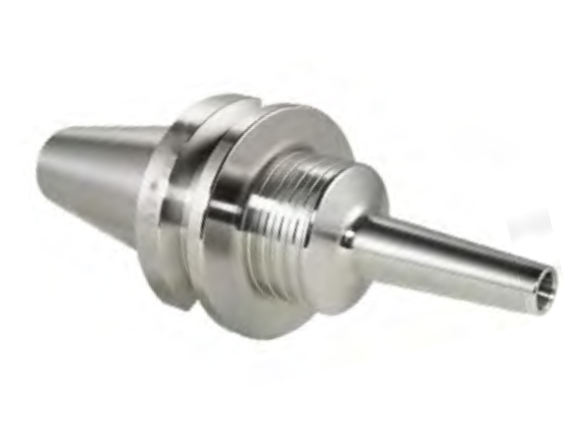
- BT pull stud (through coolant) — BT40/BT50, 45°/60°/90° outlets, dimension drawing on the page.
- HSK coolant pipe nozzle — HSK32-CP to HSK100-CP, M10×1.0 to M24×1.0.
- ER coolant collet — ERS11 3–7 mm through ERS50 12–34 mm.
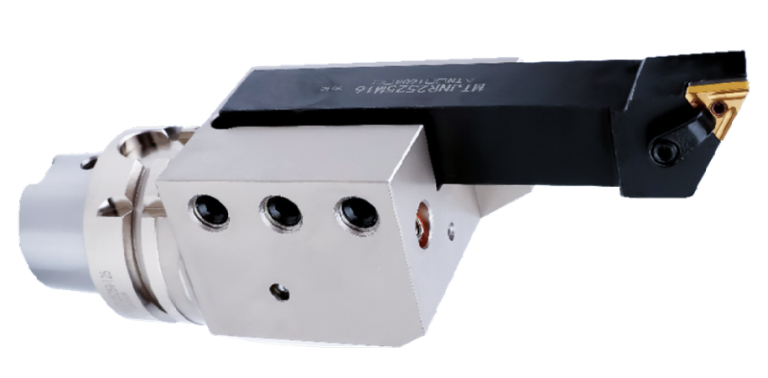
- BMT 90° driven tool holder (through-coolant) and BMT 0° for turning centres.
Coolant that reaches the edge is a sealing problem before it is a pressure problem.
MOQ 1 piece, in-stock items ship in 3–7 days, made-to-order 15–60 days.