HSK-T vs HSK-A: What Changes on a Turning-Milling Centre
Short answer: both are hollow-taper (HSK) interfaces to DIN 69893 / ISO 12164, so they share the 1:10 taper and the short, repeatable seating. HSK-A is the general machining variant; HSK-T adds widened drive keyways so the same interface can transmit torque in turning operations on turn-mill machines. If your machine turns as well as mills, the drive-key geometry is the deciding detail.
The shared foundation
HSK is a hollow taper: the taper is 1:10, the shank is hollow, and clamping happens from inside the spindle. Compared with a steep taper (BT/SK/CAT at 7:24), HSK seats on both taper and face, which gives high repeatability at the spindle nose and makes it the usual choice for higher spindle speeds.
Because the taper and the clamping mechanism are shared, HSK-A and HSK-T holders look similar in a catalogue photo. The difference is in the drive.
What HSK-T changes
On a turning centre, cutting force arrives sideways and continuously — the tool is not just spinning, it is being pushed through material at an engagement angle. The drive keys therefore carry load in a way they rarely do in pure milling.
HSK-T uses wider drive keyways than HSK-A so that the same interface can transmit that turning torque. In practice:
- HSK-A — milling, drilling, boring on machining centres; the standard choice for rotating-only operations.
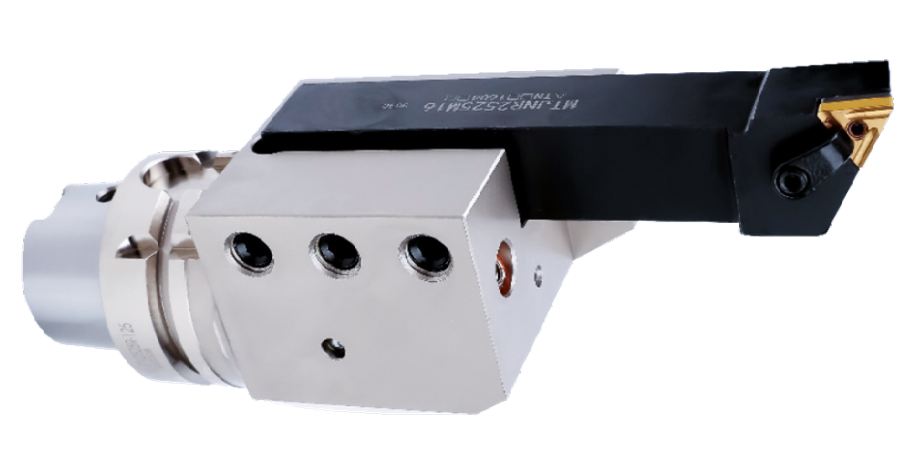
- HSK-T — turning tools (external, internal, grooving, threading) held in an HSK spindle on a turn-mill or mill-turn machine.
Using an HSK-A holder for a heavy turning operation is not a dimensional error — it fits the spindle — but the drive is not designed for that duty cycle. That is the mistake worth avoiding.
Comparison
| HSK-A | HSK-T | |
|---|---|---|
| Taper | 1:10 hollow taper | 1:10 hollow taper |
| Drive keys | Standard width | Wider, for turning torque |
| Primary use | Milling, drilling, boring | Turning, grooving, threading on turn-mill |
| Common sizes | HSK-A32 … A100 | HSK-T40, T50, T63 (size follows spindle) |
| Interchangeable? | Fits the same spindle; duty differs | Fits the same spindle; duty differs |
What we stock in HSK-T
Our HSK-T line covers turning and boring applications directly:
- Turning tools for facing, external turning and cut-off: HSK-T Turning Tools For Facing
- Boring bar holders and internal turning holders in the same HSK-T interface
- Full range: shop
Holders are specified by spindle size (e.g. HSK-T63), tool shank size and length. The model code carries all three — read it before ordering.
How to specify correctly
1. Read the spindle designation on the machine. It will state HSK-A63, HSK-T63 or similar. The A/T letter is not cosmetic. 2. Match the holder to the operation, not just the spindle. Turning holder for turning; milling chuck for milling. 3. Check the tool shank interface separately. HSK-T describes the machine side; the cutting tool side may be a square shank, a cylindrical shank or a boring bar connection. 4. Keep the family consistent. Mixing A and T on the same machine for the same duty is a maintenance and traceability problem.
The one-line rule
HSK-A for milling, HSK-T where the machine also turns. Same taper, different drive — and the drive is what carries the turning load.
MOQ 1 piece, in-stock items ship in 3-7 days, made-to-order 15-60 days.