Rigid vs Tension-Compression Tapping Chucks
Short answer: on a machine with synchronised spindle and feed (rigid tapping / synchronous tapping), use a rigid tapping chuck; on machines without synchronisation, or where the tap must float axially, use a tension-compression (length-compensating) chuck. Choosing the wrong one shows up as broken taps, oversize threads or thread pitch errors.
Why the two exist
A tap is a screw. For the thread to be correct, the axial feed must match the pitch exactly.
- Synchronised machines drive spindle rotation and Z feed from the same encoder, so the tap can be held rigidly — no axial float is needed, and float would actually introduce error.
- Non-synchronised machines cannot guarantee that match. The tap must be allowed to pull itself in (tension) or push back (compression). That is what a tension-compression chuck provides.
Comparison
| Rigid tapping chuck | Tension-compression chuck | |
|---|---|---|
| Machine requirement | Synchronised spindle and feed | Any machine, including older ones |
| Axial float | None (rigid) | Tension and compression stroke |
| Thread accuracy | Highest — pitch follows the machine | Good, limited by compensation range |
| Tap breakage risk | Higher if synchronisation is poor | Lower — float absorbs mismatch |
| Speed | Higher, no float to take up | Limited by compensation travel |
| Best for | Modern VMC / HMC with rigid tapping | Drilling machines, older VMCs, mixed setups |
How to tell what you need
1. Check the machine's tapping capability. If the control offers a synchronous tapping cycle (and the spindle has an encoder), you are in rigid territory.
2. Check the tap. Forming taps and high-precision threads reward rigidity. Long taps and small diameters are less forgiving of mismatch.
3. Check the operation. Blind holes with a depth limit need predictable axial behaviour; through holes tolerate more float.
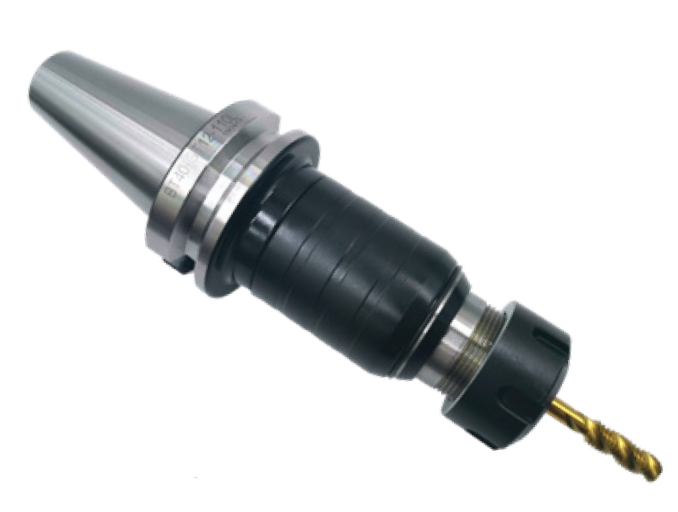
4. Check the holder series. Our GT-type tapping chucks are tension-compression designs; TER series holders are the rigid-style connection used with synchronised machines. Verify the series against the machine's capability rather than assuming.
Symptoms of the wrong choice
| Symptom | Likely cause |
|---|---|
| Tap breaks at the start of the hole | Rigid chuck on a non-synchronised machine |
| Thread pitch looks stretched or compressed | Compensation range exceeded, or worn chuck |
| Oversize thread | Tap wandering — insufficient guidance or wrong chuck |
| Tap pulls out of the holder | Insufficient clamping for the tap shank size |
What we stock
- Rigid-style tapping holders: BT-TER-A Rigid Tension Tapping Chuck and CAT-TER-A
- Tension-compression (GT) tapping chucks in BT and HSK versions
- Full range: shop
The one-line rule
Synchronised machine → rigid chuck. Anything else → tension-compression. The machine decides, not the tap catalogue.
MOQ 1 piece, in-stock items ship in 3-7 days, made-to-order 15-60 days.