How to Choose Jaw Width and Opening for a Machine Vise
Short answer: jaw width is set by the largest part cross-section you need to grip rigidly; opening is set by the widest part you will ever clamp between the jaws. Buy for the widest part in the next two years, not the one on the bench today — a vise that is 20 mm too small is a vise you replace.
The two numbers that matter
Jaw width (A) — the length of the jaw face. Wider jaws spread clamping force over more surface and resist part rotation on heavy cuts.
Jaw opening (C) — the maximum distance between the jaws. This decides what physically fits.
A third number, jaw height (B), decides how much of the part sits between the jaws and how much clearance you have for the tool above the part.
Typical size progression
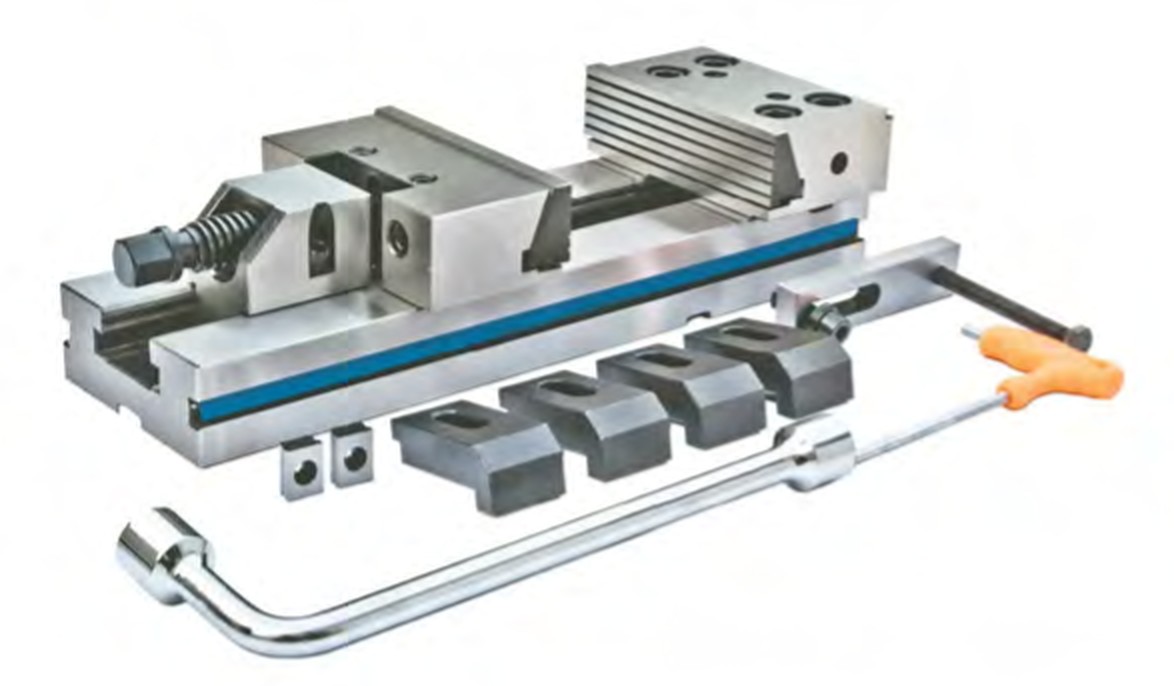
Using our ART.1 standard vise as a reference, the series runs from a 100 mm jaw width with 100 mm opening up to a 300 mm jaw width with 800 mm opening:
| Model | Jaw width A | Jaw height B | Jaw opening C |
|---|---|---|---|
| ART.1-1×100 | 100 | 30 | 100 |
| ART.1-2×150 | 125 | 40 | 150 |
| ART.1-3×200 | 150 | 50 | 200 |
| ART.1-3×300 | 150 | 50 | 300 |
| ART.1-4×200 | 175 | 60 | 200 |
| ART.1-6×700 | 300 | 80 | 700 |
| ART.1-6×800 | 300 | 80 | 800 |
The pattern is deliberate: opening grows faster than jaw width, because a long part needs travel, not necessarily more jaw face.
How to choose
1. Measure the widest part. Not the average — the widest. Add clearance for the fixture or parallels.
2. Check jaw height against the cut. A tall part in short jaws behaves like a lever. If the part is tall relative to jaw height, plan for a taller jaw or support the overhang.
3. Match the vise to the table. Base length and bolt pattern decide whether the vise fits the T-slots and whether you still have travel left.
4. Consider the machine, not just the part. A 300 mm vise on a small VMC can consume most of the table.
5. Think about the second operation. If you will hold a fixture plate later, opening matters more than jaw width.
Common mistakes
- Buying for the current job only. The next part is usually bigger.
- Confusing opening with stroke. Opening is the maximum; the useful working range is narrower once jaws are fitted.
- Ignoring jaw height. Chatter on tall parts is often a jaw geometry problem, not a speed/feed problem.
- Over-buying width. A very wide vise on a small machine reduces rigidity and travel.
What we stock
- Reference model: ART.1 Standard Vise — 20 sizes, jaw 100–300 mm, opening 100–800 mm, jaws at HRC 58-62
- Larger-opening version: ART.20 Single Large Opening XL Vise
- Full range: shop
All ART.1 jaws are carburized alloy steel, HRC 58-62, with parallelism and squareness held to 0.005 mm/100 mm.
The one-line rule
Size the opening for the widest part you expect in two years, and the jaw width for the rigidity your heaviest cut needs. Everything else is detail.
MOQ 1 piece, in-stock items ship in 3-7 days, made-to-order 15-60 days.